
Singapore Form 14A: fields, PDF and filing route
Short answer
Singapore Form 14A is the entry-visa application form. See what its identity, passport, trip, local-contact and declaration fields mean, and why the free PDF alone is not a filing route.
- Last updated:
- 2026-09-13
- Form 14A route
- VisatoSingapore prepares Form 14A and supports eligible filing
- Final decision
- ICA decides visa approval and checkpoint entry
- Official sources
Last updated: 2026-09-13
- ICA — current Form 14A
- ICA — Downloadable forms (Form 14A)
- ICA — submitting Form 14A and V39A online
Singapore Form 14A is the application form used for a Singapore entry-visa case when the traveller's passport or travel document requires a visa before travel. It asks for identity, passport, trip, Singapore address, local-contact or sponsor context, antecedent answers and a declaration. ICA provides the current PDF free of charge; completing or downloading it does not file the visa application.
This page explains what the form is and what its sections ask. When you are ready to enter the details, move to the separate field-by-field guide on how to fill Singapore Form 14A.
What Singapore Form 14A is
Form 14A records the applicant and trip details used in a Singapore entry-visa application. It is not the free SG Arrival Card, the e-Visa result issued after approval, or an application for a work pass or Student's Pass.
Download the current Form 14A only from ICA or a Singapore Overseas Mission, then confirm the filing route that applies to the traveller. A saved or signed PDF is preparation, not proof that the application has been lodged.
Form 14A PDF is not the same as submission
The Form 14A PDF helps you understand the fields, but downloading it does not submit an application. For India and other visa-required travel documents, ICA describes submission through a strategic partner, Singapore local contact, Singapore Overseas Mission or authorised visa agent route depending on the case.
That is why the safest sequence is route first, then form. Confirm who can submit the application, prepare the current Form 14A details in English, attach the required photo and passport biodata copy, and keep any case-specific supporting documents ready before payment or filing.
Part I: identity, passport and home address
Personal fields include your passport name, alias, birth date and place, sex, marital status, spouse's citizenship where applicable, race and nationality. Race and nationality are separate fields. State the actual travel-document type; answer a nationality-specific field only if it applies to you.

The first part includes your personal details AND your travel document; the passport is not a separate Part II. Copy the document number, issue and expiry dates from the passport you will use. The home or residence address continues on page 2. Do not substitute your Singapore hotel for your home address.
Part II: work, income and the visit
Other details include email, phone, occupation, highest educational or professional qualification and religion. Use records that match your own circumstances; do not copy a sample occupation or qualification to fill a blank.
Enter annual income in SGD, not monthly pay or the balance in your bank account. This part also covers your planned visit and Singapore accommodation. The requested number of journeys is different from the intended length of stay; neither answer determines the stay ICA will grant.
The following page asks about residence in other countries for at least one year during the last five years. The travelling-companion fields concern applicants aged 12 or younger at application, with the stated airline-representative exception. Read these conditions before leaving the fields blank.
Part III: local contact, company or hotel
The printed heading explicitly allows details of a local contact, company or hotel. Give the real relationship and contact information. Naming your hotel here does not make it an eligible submitter or a signer of Form V39A. Confirm those roles separately through your filing route.
Part IV: previous events
Read each yes/no question in full. Refusal of entry and deportation, court convictions, prohibition from entering Singapore, and previous entry using different identity details are separate questions. Explain a yes answer where the form asks. If an event is unclear, give the actual record to the filing party for clarification; do not turn an uncertain answer into no.
Does a visa rejection mean I was refused entry on Form 14A?
Part IV asks about refusal of entry or deportation from any country or place, including Singapore. A rejected visa application is a different decision; it does not by itself show that you were refused entry. Do not choose yes or no solely because a visa was rejected. Read the exact question against what happened. If the record is unclear, show the decision document to your filing party before answering. Answer any separate question about visa rejections truthfully.
Does renewing my passport mean I entered Singapore under a different identity?
The prior-entry question concerns entering Singapore using a different name, sex, nationality/citizenship or date of birth. Renewing a passport with the same identity details, even if its number changes, is not the event described. Check the details used on your previous entry against your current details; do not choose an answer from the passport number alone. Explain a yes answer as requested. If unsure, show the old and current records to your filing party rather than hiding a relevant change.
Part V: declaration and signature
Check the completed answers before signing and dating the declaration. You remain responsible for the information even if someone else types it. The declaration also includes undertakings about activities during the stay; a completed visa form does not authorise employment or guarantee entry.
Worked check: annual income is not the account balance
Suppose your fixed monthly income is already expressed in SGD and is S$3,200 for all 12 months, with no other income. The annual figure is S$38,400, not 3,200 and not your current savings. This is an arithmetic example, not a minimum income requirement.
If income varies, use your actual records instead of multiplying one unusually high month by 12. If it is in another currency, keep the conversion date and rate with your working notes and follow the filing route's instructions. Never copy the example figure into your application.
What a completed Form 14A does not do
A completed or signed Form 14A does not submit the application, pay ICA's fee, create an e-Visa or guarantee approval. It is one part of the visa file and still has to move through a permitted filing route. ICA remains the decision-maker and may request additional information for an individual case.
Where can I download the Singapore Form 14A PDF?
Download the current Form 14A PDF free from ICA or the relevant Singapore Overseas Mission. Avoid relying on an old copied file: confirm the live official version and the filing instructions for the traveller's passport before completing it.
Can I submit Form 14A online myself?
Downloading or completing Form 14A is not submission by itself. The application must use a permitted route for the passport and filing location, such as an eligible Singapore local contact or strategic partner, or a Singapore Overseas Mission and its appointed authorised visa agent where applicable.
Is Form 14A the same as the SG Arrival Card?
No. Form 14A is part of a Singapore entry-visa application for a traveller who needs that visa. The SG Arrival Card is a separate free arrival declaration and does not replace Form 14A or create an entry visa.
Prepare before you type
Form 14A field map: the details to collect
The current ICA form has five parts. Use this map to gather the right details, then check every entry against the passport and supporting documents before the applicant signs.
| Form | Field group | Details to prepare | Before signing |
|---|---|---|---|
| Part I | Identity, passport and residence | Passport name, alias, date of birth, sex, marital status, spouse status, place of birth, race, nationality, travel-document details and home address. | Copy identity and document details exactly from the current passport; do not shorten or tidy the name. |
| Part II | Contact, work and trip | Email, phone, occupation, education, annual income in SGD, religion, arrival date, requested visa type, purpose and intended stay. | Keep dates and trip details consistent with the supporting documents. ICA decides the visa type and validity it issues. |
| Part II | Singapore stay and travel history | Accommodation type and address, stays of one year or more in other countries during the last five years, and companion details for an applicant aged 12 or younger when applicable. | Use a real accommodation address and provide the additional history or child-companion details only where the form asks for them. |
| Part III | Local contact, company or hotel | Name, relationship to the applicant, contact number and email for the relevant Singapore contact, company or hotel. | Confirm the permitted filing route separately; naming a hotel or contact on the form does not submit the application. |
| Parts IV-V | Antecedents and declaration | Entry refusals or deportations, convictions, Singapore entry prohibitions, prior use of a different identity, explanations, date and signature. | Answer every declaration truthfully and add the requested explanation when an answer is yes. |
The official PDF is free and may change. Use the current Form 14A linked in the official sources below; downloading or completing it is preparation, not proof of submission.
Understand the form first
Singapore Form 14A: from fields and PDF to the right filing route
Start with the field-by-field guide, then choose preparation or the wider visa application flow. The free PDF is not a submission by itself, and photo, documents, e-Visa status, SG Arrival Card and pass questions each have their own route.
See what you receive
Form 14A examples: from review to ICA filing
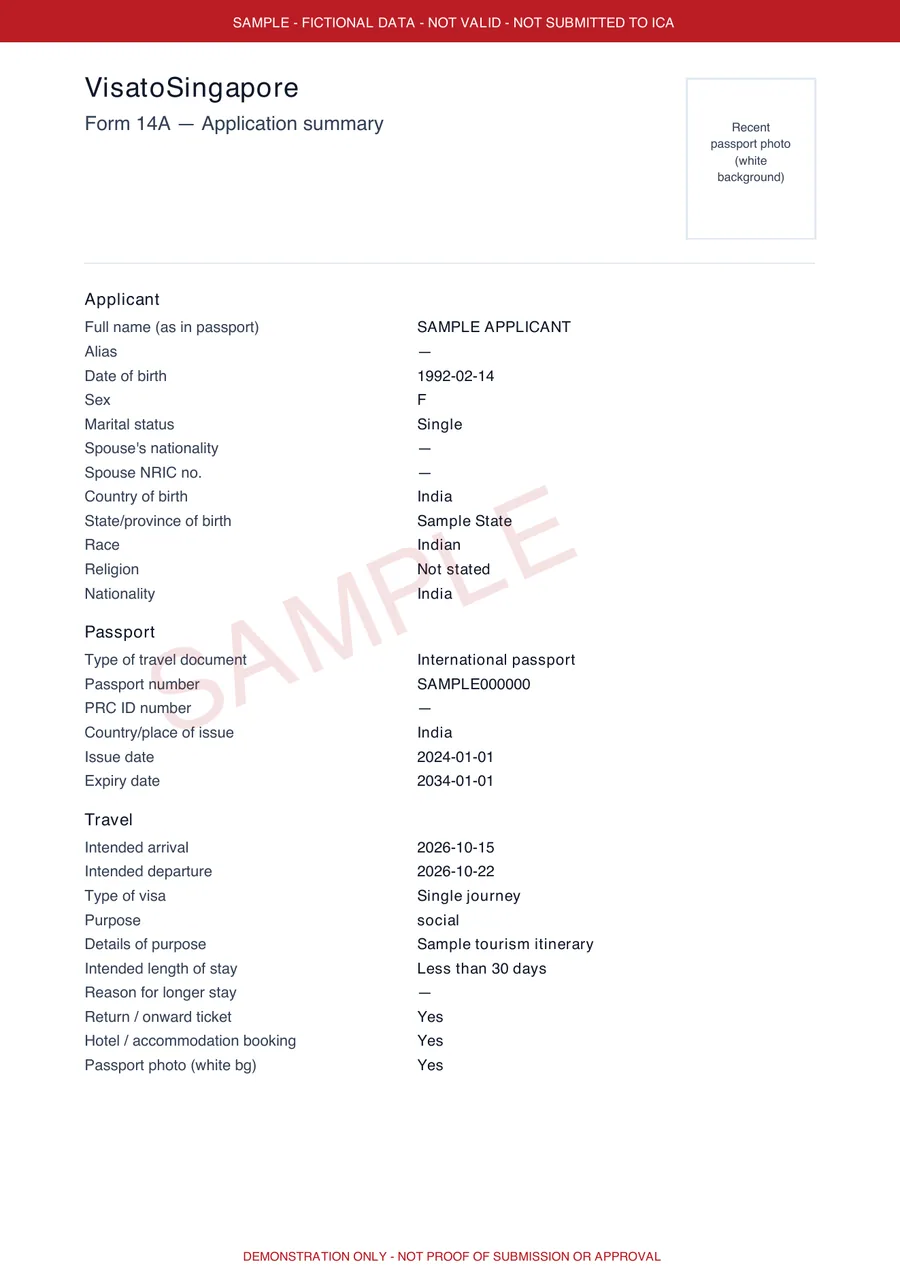
These SAMPLE documents use fictional data. They are not customer files, were never submitted to ICA and are not proof of submission or approval.
Your review copy
You receive a secure review link and a branded summary PDF. Check the passport, contact and trip details before anything is filed.
SAMPLE · Fictional data · Not submitted
View SAMPLE PDF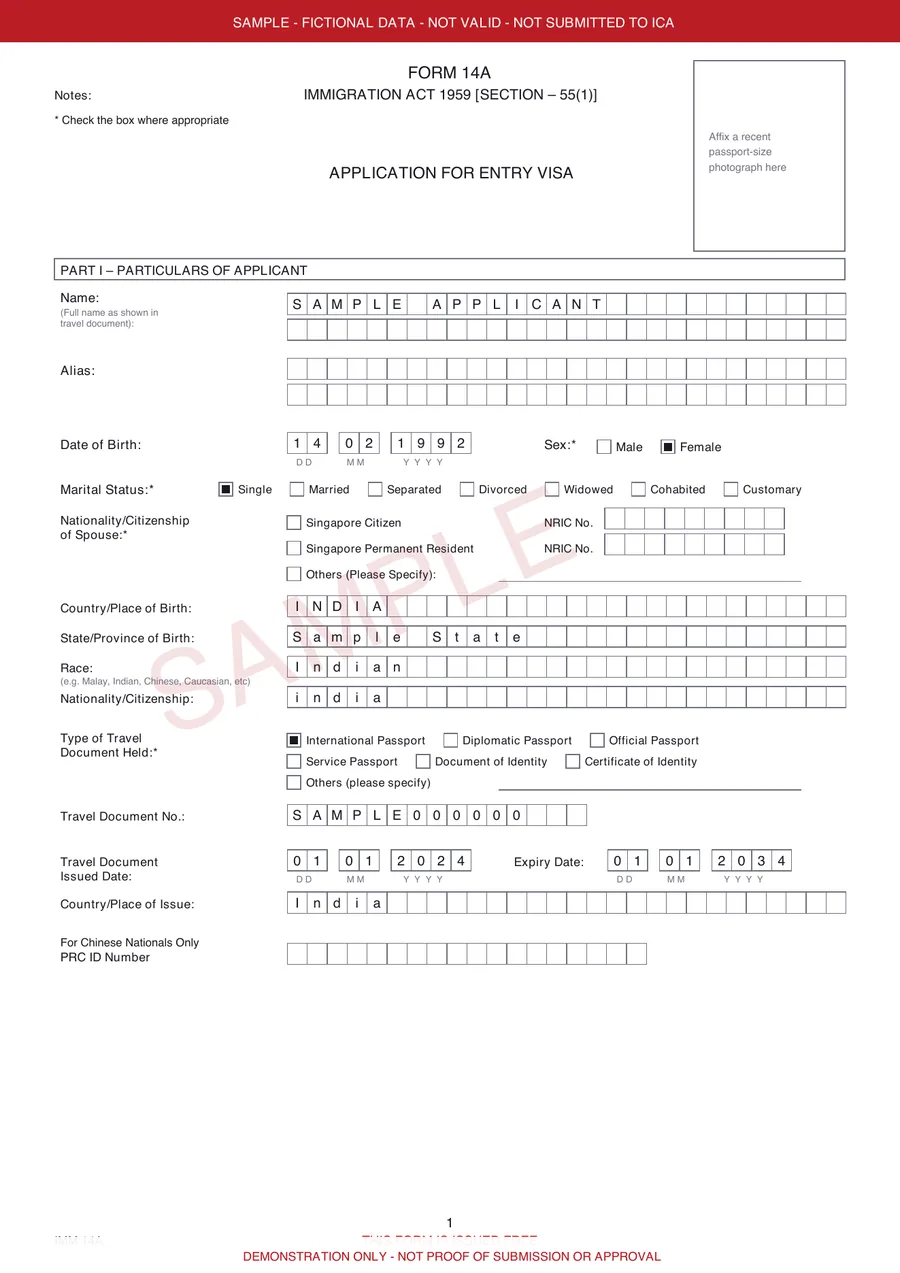
Form 14A / IMM 14A
Form-only customers also receive the prepared IMM 14A to give to their permitted submitter after review. The SAMPLE PDF below is not a filed application.
SAMPLE IMM 14A · Fictional · Not submitted
What arrives by email
The email contains your review link, the branded summary PDF and the next step. Form-only customers also receive the prepared IMM 14A. This is not an ICA decision.
What the permitted filer submits
The permitted filer enters the application data and uses the photo and supporting documents in ICA's e-Service, including SAVE where applicable. ICA says hardcopies of Form 14A and V39A are not required for an online application unless ICA requests them.
After a real submission
An ICA application reference confirms submission, not approval. If ICA approves the application, the e-Visa is delivered separately; permission to enter is still decided by ICA at the checkpoint.
Independent service, not affiliated with ICA or the Singapore Government. Every example is fictional and was never submitted.
Next useful route
Continue with the right Singapore check
Use these links to move from this article into the matching visa, SG Arrival Card, Form 14A, transit or pass route without starting from scratch.
Sources
VisatoSingapore
Who we are
Our editorial team maintains these materials using the linked primary ICA, MFA and MOM sources. This information is not legal advice.
- Role
- Independent Singapore visa information, Form 14A preparation and filing-support service.
- What we do
- Fill in and proofread Form 14A, reconcile the supporting documents, and file eligible cases through a route ICA permits.
- What we do not do
- We are not ICA, do not issue visas, and do not guarantee approval or entry.
- Decision maker
- Final visa approval and checkpoint-entry decisions remain with Singapore's ICA.